Urban Maxim: Unlocking Multi-Layered Depth in Typography
Understanding the Layered Approach
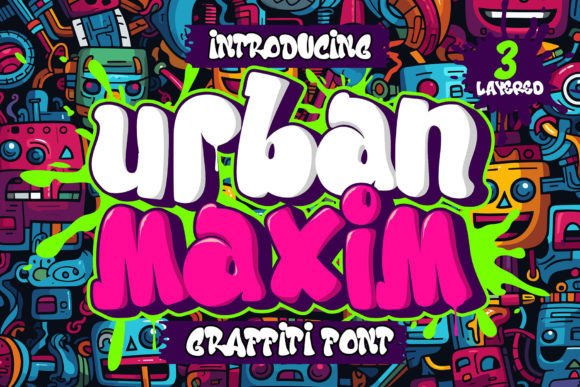
In the realm of digital design, typography often serves as the primary vehicle for communication, yet standard flat text can sometimes fail to capture the dynamic energy required for specific projects. Urban Maxim addresses this limitation by offering a specialized graffiti font architecture that relies on a multi-layered system. Unlike conventional typefaces that function as a single entity, this font is designed to be stacked. It utilizes three distinct layers—solid, shadow, and inner shadow—to construct a cohesive visual unit. This methodology allows designers to manually build depth, creating a three-dimensional appearance that is difficult to achieve with standard text effects alone.
The fundamental concept behind Urban Maxim is the separation of dimensional attributes. By isolating the solid base, the drop shadow, and the internal shading into individual font files or styles, the user gains granular control over the final output. This approach is particularly relevant for creators who need precise color manipulation. For instance, the shadow layer can be assigned a completely different hue than the solid base, or the inner shadow can be rendered in a gradient to simulate metallic sheens or lighting conditions that standard CSS text-shadows cannot replicate accurately.
Practical Application and Workflow Integration
From a practical standpoint, integrating Urban Maxim into a workflow requires a slightly different approach than typing out a sentence in a word processor. Because the effect is built through layering, the designer typically needs to duplicate the text element twice. In software like Adobe Photoshop or Illustrator, this involves creating three separate text layers, aligning them perfectly, and then arranging the stacking order so the shadow sits at the back, the solid in the middle, and the inner shadow on top.
While this process adds a few steps to the design phase, the result is a level of customization that pre-baked effects cannot match. The ability to modify the kerning and tracking of the shadow layer independently of the solid layer, for example, allows for the creation of long, dramatic cast shadows that stretch across the canvas. This flexibility makes Urban Maxim a potent tool for visual storytelling, where the typography itself needs to act as an illustration rather than just readable information.
Visual Impact in Street Art and Poster Design
The aesthetic of Urban Maxim is heavily rooted in street culture and urban art. The letterforms exhibit the irregular, energetic strokes characteristic of graffiti tags, making them suitable for projects that aim to convey rawness, rebellion, or high energy. However, the utility of this font extends beyond literal street art applications. It is frequently employed in poster design, album covers, and event flyers where the goal is to arrest the viewer's attention immediately.
In these contexts, the 3D effect provided by the font layers ensures that the text does not get lost against complex backgrounds. A standard sans-serif font might require a solid background box to remain legible over a photograph, but a fully rendered Urban Maxim design stands on its own. The depth created by the shadow layers provides enough separation from the environment, allowing the typography to overlap with background elements without sacrificing readability. This characteristic is particularly valuable in editorial layouts and magazine covers that seek a modern, edgy aesthetic.
Target Audience and Use Cases
While the visual style of Urban Maxim is distinct, its utility spans a broad range of professional scenarios. Marketers looking to create bold headlines for youth-oriented brands or campaigns targeting Gen Z audiences will find the font’s aesthetic aligns well with current trends in pop culture. Similarly, game designers and content creators on platforms like YouTube or Twitch can use the font to create thumbnails, logos, and overlays that convey action and intensity.
Small business owners, particularly those in the fashion, music, or skateboarding industries, can leverage the font to build a brand identity that feels authentic and culturally relevant. However, it is important to recognize the specific nature of the font. Urban Maxim is not designed for long-form body copy or corporate reports. Its irregular baseline and decorative nature make it difficult to read in small sizes or dense paragraphs. It is best utilized as a display typeface—meant for headlines, logos, and single-word emphasis—rather than a workhorse font for general text.
Technical Quality and Reliability
Evaluating the technical execution of Urban Maxim reveals a focus on consistency across the three layers. A common issue with multi-layer fonts is misalignment or "jitter" when the layers are stacked, resulting in a blurry or glitchy appearance. However, this font set is engineered to align perfectly when the baseline and kerning settings are synchronized. The vector paths are clean, allowing for significant scaling without pixelation, which is essential for large-format printing such as banners and billboards.
The reliability of the font files also plays a role in its effectiveness. Designers working under tight deadlines cannot afford font files that crash rendering software or fail to load specific glyphs. Urban Maxim generally functions as a standard OpenType or TrueType set, ensuring compatibility with major operating systems and design software. This stability makes it a dependable choice for professional environments where file integrity is paramount.
Customization and Long-Term Value
The long-term value of a font like Urban Maxim lies in its versatility despite its niche appearance. Because the layers are distinct, the user is not locked into a single "look." By changing the color combinations of the solid, shadow, and inner shadow layers, the font can take on vastly different personalities. It can look like vintage neon signage with bright colors and dark outlines, or it can resemble embossed leather with subtle earth tones.
This adaptability ensures that the asset does not become obsolete after a single project. A designer can purchase or download Urban Maxim and use it repeatedly across different campaigns for the same client—or for different clients—simply by altering the layer treatments. This provides a high return on investment for freelancers and agencies who need to maintain a library of flexible assets that can be tailored to specific client needs without requiring new purchases for every distinct style.
Considerations and Limitations
Despite its strengths, there are practical considerations to keep in mind. The primary limitation of Urban Maxim is the time investment required to set it up. Unlike a "one-click" 3D effect in a design program, the manual layering process can be tedious if the designer is working with a large amount of text. If a headline changes, the designer must update three separate text boxes to ensure the layers remain synchronized.
Furthermore, the file size of the project may increase due to the multiple layers of vector data, which can be a minor concern for web-based applications where load times are critical. However, for print and static image design, this is rarely an issue. Ultimately, Urban Maxim is a specialized tool. It is not a replacement for standard typefaces but rather a complement to them, used when the design requirement specifically calls for high-impact, dimensional typography. For designers who prioritize visual punch and have the workflow to support layered text construction, it remains a valuable and effective resource.